Showing posts with label fiber. Show all posts

Friday, May 6, 2011

My Main Romaine


I am finally getting back to the question of Romaine! Mom asked the other day why I love Romaine so much. It’s because it’s so darn healthy! Now don’t get me wrong, I’m not placing it above or below other leafy greens!! They all have their own benefits to your body. Romaine is simply one that Dave likes more, so I tend to use it often to keep him enjoying his salads, smoothies, and wraps!


It’s got a crisp, clean crunch that brings a mild flavor. Plus, a 2-cup serving provides over 140% of your day’s needs for Vitamin K and almost 60% of Vitamin A! It is also an excellent source of folate, manganese, and chromium; and a very good source of fiber, vitamins B1 and B2, and minerals potassium, molybdenum, iron, and phosphorous!


At only 15 calories, that seems like a pretty good deal!


Romaine is one of the few plant sources of chromium, so that’s another reason I like it! Onions, broccoli, and tomatoes are also contributors (hooray for chromium salads!)


Plus, and take this with a LARGE grain of salt - Celtic sea salt, of course! ;-) - I have this notion floating around in my head that chromium may help reverse graying hair! I cannot recall for sure where this idea came from, but it’s something that niggles at the back on my mind. (To the Research Cave, Robin!) And I have had friends, and read accounts of others, who have noticed their own hair color returning after adding daily green smoothies to their diets!! It didn’t happen right away, but after a month or so, they noticed darkening areas where they’d more recently been silvery! Woohoo! So perhaps it’s just the general nutrition gained from adding a smoothie (and thereby eliminating a less healthy breakfast option) or perhaps it’s a specific nutrient. I will research more one day!


But back to Romaine! Here’s another good health combo… the beta-carotene plus the vitamin C work together to help keep down bad cholesterol!


When cholesterol gets oxidized, it becomes the sticky, nasty plaque that clings to your arteries. This begins to block the passage of blood, narrowing the artery and making it harder for your body to get that nutrient-rich blood around! So then, in comes higher blood pressure, less oxygen and energy getting transported, and possibly even heart attack or stroke after too long. Beta-carotene and Vitamin C help prevent this awful oxidation, helping to keep your blood a’flowin’ easily! And then the fiber can come along and help sweep out the gunk and help you excrete it. (I know, fun topic!)


From MyPyramid.gov


Just try to get organic, as this is one of those Dirty Dozen highly sprayed veggies!


Have a great weekend, my friends! Tomorrow is another 5K run! Woo!


~Katie
So! Romaine! Yet another great green to add to your life! Salads and smoothies are the easy route, but there’s plenty you can do! Add it to casseroles or sandwiches; or just use it in place of bread for sandwiches, buns, or tacos; use the smaller, firmer leaves as boats for fun toppings like salsa, avocado, or julienned veggies; or use it like a sushi wrapper!

Wednesday, March 30, 2011

Lovely Veggie Chili and Onion Bread

Good Wednesday lunch break, my friends! How is your week? Hopefully going by quickly and happily!

It has turned cold again - yuck! It was actually SNOWING this morning when I left for work - and I see it falling now! So, that's always a good time to figure out warmer comfort foods - but still healthy! While I sometimes crave the cheesy pizza or fat-and-cream-laden soups, I have been having fun trying to find healthier ways to cope!

A few days ago, I posed the tropical salad - and as wonderful as that is, I know it's not warming! (But sure makes me smile and think back to Saipan.)

Over the weekend, I tried my hand at making a "raw" Onion Bread and Chili. And I was very happy with the results!

So first, the onion bread, which I found on at GoneRaw.com posted by Kandace here. (It's the first recipe posted on the site, over 4 years ago! I figure I'll just start there, and work my way forward to the present!) ;-)

Recipe:
Based on a recipe by Matt Amsden in RAWVolution.

Ingredients:
3 yellow onions, large
1 cup flax seeds (golden, brown or a combo), ground
1 cup raw sunflower seeds, ground in a food processor
½ cup Braggs Liquid Aminos or Nama Shoyu
¼ cup cold pressed olive oil

Preparation:
1.Peel and half the onions. Slice in a food processor (with slicing disc) or by hand
2.Place onions in large bowl and mix with rest of ingredients until thoroughly combined.
3.Spread mix over a Teflex sheet and repeat until all of mixture is used (I usually end up using 2 sheets).
4.Dehydrate at 100°F for 24 hours. Flip and return to dehydrator for 12 hours.
5.Cut into 9 equal pieces (2 cuts horizontally, 2 cuts vertically). Usually makes 18 pieces

I'm not sure if I did the recipe correctly, because I only used half the onion amount - I just couldn't get more onion to mix in! I also decreased the Braggs Aminos to 1/4 cup because that stuff is salty! Then I added a little more water to make up the fluid difference. I think I over-processed the seeds, because it was more a paste than a grainy texture. But the flavor was still good!

So that big bowl was then spread out on my dehydrator sheet, on parchment paper. Again, not sure if I did something wrong, because I only got 1 sheet out of it instead of 2. Maybe she makes hers thinner? Or perhaps that extra onion would carry it further.
And after quite a long dry time, it comes out a deep caramel brown!


The benefits of this bread: (I hope you're sitting! This is a doozie!)

Onion is not often the first food that comes to mind when I picture healthy foods. I often think of it simply as a condiment to other foods - and it does go great with many items! But it also carries many health benefits of its own. (And I loooooove the taste!) Onions can help reduce the risk of various cancers, such as colorectal, laryngeal, and ovarian cancer if eaten regularly (study showed 1-7 times weekly reduced risk). Onions also help increase bone density - something good for all of us, especially for menopausal-aged women who often have some density loss! They also have a good dose of chromium, which helps maintain healthy blood sugar and cholesterol levels.

Flaxseeds are one of my favorite forms for getting my Omegas (I also love chia seeds, hemp seeds, and walnuts! And of course, pretty much all leafy greens have some omega fats in them - just in small amounts.) But these lovely little seeds are also a rich source of fiber and manganese. They are also anti-inflammatory, help keep bones healthy, protect against cancer, diabetes, heart disease, and hypertension! And one small study found that it helped reduce the frequency and intensity of hot flashes.

Sunflower seeds are a rich source of magnesium, which can help calm nerves and muscles, and sometimes even help with migraines! They also contain selenium - one of thsoe beautifying minerals! But it is also is a helpful component of the powerful enzyme glutathione peroxidase, which your liver uses to detoxify a range of potentially harmful molecules.

Braggs Liquid Aminos (what I used) is similar to soy sauce. It's got that same salty, savory flavor, but it contains 16 different amino acids (that make up proteins.) Plus it's organic, non-GMO. (Which I am a BIG fan of avoiding!! I try not to buy anything with non-organic soy or corn. But that topic is best left for a different post some day.)

Olive oil has been all over the news as being healthy. And it is! But it is liquid fat, so keep that in mind if you're a calorie counter! Usually 14g of fat per Tablespoon - but at least it's mostly monounsaturated fats (MUFAs) which are some of the healthier types! In limited amounts, olive oil will provide some wonderful things! When used INSTEAD OF (not IN ADDITION TO) animal fats and butters or other bad fats, olive oil has been found to help protect against degenerative diseases like atherosclerosis, diabetes, asthma, colon cancer, and arthritis, as well as protecting against heart disease. And more? It's got some good antioxidants phenolic compounds to help with other protective effects! When picking out an oilive oi, try to get Cold Pressed Virgin, as this will help maintain the flavor and health value of the oils better than the more refined forms.

* * * * * * * * * *


So back to the meal... Once the bread is done, I put in on the side with some chili from my Live Food Cuisine book. The base is a delectable blend of sun dried tomatoes, fresh tomatoes, spices - and avocado to make it nice and creamy! Then it's got some good chunky veggie bits in it for good hardy noms! Then I let it sit in the dehydrator for a little to warm it up some (but not so hot as to cook out all my lovely nutrients and enzymes!)

The "sour cream" is a blend of macadamia nuts, sunflower seeds, and some lemon and salt. I wouldn't say it tasted much like sour cream (and I should have added extra water to get the consistency different) but it was good! And it helped complement and tame the extra cayenne I'd accidentally put in the chili!

So with the spicy chili and the zesty onion bread crackers, a nice side of cool cucumber was the perfect companion to this dinner!

My new dishes!! I had to buy this set because it was so colorful and just made me happy!


I am sad that my chili is now gone, since I can look outside and see snow still falling. Plus, even Dave liked this one! (Ok, so, the first time he tried it, he was actually spreading it on a slice of cheese pizza... but I suppose that's better than nothing!) Now he wants to learn how to make this on his own, so he can have it more often!

I hope you all have a warm and hearty day! Stay warm, stay dry, stay smiley ^.^

Warm Wishes!
~Katie
That is one hearty bread I think I'll be making in bigger batches in the future! They also made good crackers when I cut them smaller and let them dehydrate a little longer :) (Plus, onions, flax, and sunflower seeds are all pretty cheap! It's just the Braggs that gets a little pricier - but perhaps I can find some substitute of just using water and my Celtic sea salt.)

Thursday, March 24, 2011

Tropical Salad on a Wintery Day

Hello all! :) Today I wanted something that reminded me of WARM WEATHER! I was so excited by the warmer days we had, and then this!! Cold and rainy, and even little flakes of SNOW!! Gaaa!!!

So I went to the store, and treated myself to some wonderful, healthy, enzyme and nutrient rich tropical fruits!


And I made a beautiful, colorful salad! Pineapple, papaya, banana, and half an avocado... with a splash of lime juice, a sprinkle of cinnamon, and a handful of macadamia nuts! Very much like my tropical smoothie (just blend!) but I wanted to savor the unique flavors of each fruit, and I am a sucker for texture - and I crave the little crunch of the nuts in this dish!

This pretty plate packs a punch! With over 100% of the RDA for Manganese and Vitamin C, it also carries a healthy dose of Potassium, Magnesium, Vitamin A, Vitamin K, Thiamin, Folate, and even the lovely B-6! And over 10 grams of protein and 20 grams of fiber! AND! It's rich in phytosterols, which are good to help maintain healthy cholesterol levels. That's one heck of a meal there, my friend!

Now I should go turn on some Hawaiian music, put on the flip-flops, and relax ;-)

Have a great week everyone!

Hugs!
~Katie

Tuesday, November 23, 2010

Coo-coo for Coconuts!

Cuckoo for coconuts!! ….Which, ironically, is actually not a nut, but a member of the fruit family called the drupe! (Drupey drupe! I love that word!) A drupe is simply a fruit with a fleshy outer layer surrounding a single seed or pit – like a peach, mango, cherry, etc! And in many cultures, the coconut fruit is an essential part of life. In Sanskrit it is kalpa vriksha, meaning "the tree which provides all the necessities of life". In Malay language, pokok seribu guna or "the tree of a thousand uses". And in the Philippines, the coconut is simply the "Tree of Life".


One of the newer fads in the sporting world is the wonder of coconut juice/coconut water. It is being touted as a sports-drink replacement, having substantial amounts of good rehydrating electrolytes, and without the processed sweeteners or artificial colorings or flavors. (Of course, either way, don’t forget this older post: When exercising rigorously, or in high heat, it is possible to lose in excess of 1 liter of fluids per hour! But, that’s pretty intense! Water is the best fluid replacement drink if you only exercise for 30 minutes, and/or you’re not sweating heavily. Otherwise, you risk simply replacing those calories you just worked so hard to burn!) One cup of coconut water will provide good doses of calcium, manganese, magnesium, potassium, and sodium... as well as other minerals and some vitamins - all things often lost in sweat.  Plus it has over 10% of the day's fiber!

Of course, most commercial coconut drinks have also been processed to a degree, and then packaged in little boxes or bottles, and shipped to you.

But we got the pleasure of tasting fresh, pure coconut water, straight off the tree!


While visiting a community nutrition program Office in Saipan, the groundskeeper, Frankie, offered to chop down a coconut for us! So he knocked it down, pulled out his machete, and chopped that sucker open!

See the wedge off the side - that became the spoon!

First, he chopped of a little slice off the shell, and said that would later be our “spoon.” Then he whacked the top off, and allowed us to have a sipping spout from which to drink. Dave was very skeptical at first – he’d tried some of the “juice box” versions of coconut milk I’d brought home before, and was never thrilled with them.  But I took a sip, and loved it! Considering the heat and humidity of the island had be pretty much lightly sweating 24 hours a day, I was thirsty and in need of hydration! So I chugged that sucker in no time! And it was so good! Just a mild liquid with a hint of sweetness – really not much flavor, just simple sweentess.


So, encouraged by my rave reviews, Dave sipped… and smiled!

Once we got finished drinking our coconuts juice, Frankie then chopped the entire thing down the middle, exposing the soft flesh. We got very young coconuts, which can be determined by the thickness and firmness of the flesh. The softer and thinner, the younger the coconut. This stuff was so thin and almost slimy! Quite a strange texture to a coconut newbie – almost like undercooked egg white. But the flavor was also mild – not any overpowering coconut here! And so healthy!


Coconut meat had been tossed in the “unhealthy fats” category for quite some time because it is high in saturated fats. But more research is now showing that may be an incomplete conclusion, as there are different TYPES of saturated fats. Yes, coconut is high in saturated fats, but they are shorter MEDIUM chains of fat, not LONG chains like those found in meats. These Medium Chain Fatty Acids (MCFAs) may be good for you! They may help boost thyroid functioning, therefore helping keep a healthy metabolism; and they may be quickly converted to energy instead of being stored as fat in your body. Plus, it’s a great source of Manganese with 1 small ounce containing over 20% of your day’s needs! Manganese is important for many things such as:


• Helping your body use other nutrients


• Keeping bones healthy and stong


• Maintaining normal blood sugar levels


• Keeping a healthy thyroid gland


• Promoting healthy nerves


• Protecting cells from age-inducing free radical damage


Not enough goodness in the coconut yet? Get this: the oils may also be an antifungal and antibacterial! Also, As a medicinal product, it is reputed for its wound healing, fighting fevers, regulating healthy blood clotting, and anti-inflammatory properties.  But, as always, more research is needed to know for sure! 

The oil can also be used on your body to add nourishing, healthy fats to your skin and hair!  I scoop out a small lump of solid coconut butter when I buy a new jar, and put it in a separate tub.  Then I use this in place of lotion on my feet at night, put on some socks, and go to sleep!  I have also heard of people who love to use it like a leave-on conditioner, or deep-conditioning treatment to wash off later.


So anyways, we got to enjoy the wonderful water, sample the unique meat… and even after that, sometimes the husks are saved and used to make things! At one store, we saw a purse, and hats made out of the soft fibers of the coconut coat. How resourceful!


That was one of our first wonderful tropical eating experiences on our trip! More coming soon!


Stay warm and safe this holiday season!


~Katie

Wednesday, June 16, 2010

Wednesday Words: Whole Grains 102


Welcome back, class, to Whole Grains 102! We will be continuing that exciting topic of making sure you’re getting what you want regarding whole grains! (And I’m really hoping that you WANT those whole grains, and opposed to refined “glorified sugar” versions on foods!)

I want to start off with the simple way to make sure that you ARE getting a good product – and then I’ll touch on the tricky ways companies market around it.

First, and easiest – with rice, you want brown rice. Simple! It’s brown because of that outer bran layer. The white rice has had that removed, and so reveals its naked white self. Scandalous! Put your bran on, little rice! You’re better that way!

Oats I will get in to next time.

For other items like pasta, tortillas, breads, and buns, the simple way to make sure your product is a whole grain is to check the ingredient list. The first product listed should include the word “whole.” “Whole grain flour,” “whole wheat flour,” “whole oat,” etc. Makes sense, doesn't it? You want Whole Grains, make sure it says is HAS Whole Grains!

The second thing to check is the fiber content. Look at the little nutrition label and make sure you’re getting at least 3 grams of fiber per serving.

Getting enough fiber is very important. Studies see a connection between high fiber diets and decreases in colon cancer, coronary heart disease, diabetes, and other diseases. Fiber is also critical for your natural cleansing process! It’ll push the junk on out of ya! And on the way out, it is helping prevent constipation, hemorrhoids (don’t strain!), diverticulosis, and it can even sweep out some cholesterol, helping to keep those numbers in check.

So, that’s pretty simple! Just look for “whole” ingredients, and 3g fiber!

I could stop there, but I want to point out a few marketing trickeries, so you are aware.

A wheat product isn’t the same as Whole Wheat or Whole Grain. As shown in the 101 posting, that entire kernel was a WHEAT kernel! So, even when that kernel is processed down and the good parts are removed, they can still call it Wheat Bread. But you’re smart enough to not be fooled by that now, aren't ya! You want the WHOLE grain – bran, germ, and all!

For those types of products, the ingredient list will show “enriched” in the first ingredient. Enriched white flour, enriched wheat flour, etc. And again, that enriching processes means that after refining the grain, they added back synthetic nutrients to replace the natural goodness that was lost, and in smaller amounts that originally present. Avoid these items.

Those products also usually contain little in the way of fiber – maybe having none at all! Usually I see a whopping 1 gram listed on those.

BONUS MATERIAL:
For you over-achievers out there, here’s a little side topic about a newer wheat product: What about those “white wheat” breads?


Honestly, I haven’t looked at them too much. My initial reaction was that they were just white bread, made with the empty parts of the wheat grain. But there may be more too it!
The Mayo Clinic says these are actually made with a different type of wheat. Traditional wheat products are made from Red wheat. But there is a strain of Albino wheat, and “white whole-wheat bread – like regular whole-wheat bread – is made with the whole grain” and retains the fiber and nutrients. It is a softer version, more like white bread, marketing to those who are not ready to adjust to the heartier, nuttier flavors and textures of traditional whole wheat breads

Sound too good to be true, oh White-bread lovers out there? It just may be.

In a USA Today article about this new type of bread, Marion Nestle (a favorite dietitian and author of mine!) is quoted as saying:

“Bread is flour, water, yeast, salt. Period. This [white wheat bread] has something like 20 other ingredients.... Why not buy your kids real bread?"

Evidentially, albino wheat is still treated with a long list of conditioners and chemicals to make sure it replicates that doughy, soft texture of white bread. If so, that would be a far step from natural!

I’ll have to check out albino wheat bread at the store sometime to see the ingredient list for sure, but for now… I’ll pass on the “white wheat.” Personally, I like sprouted bread, but that’s for the advanced Whole Grains 201 class in the future!

Your homework: check the ingredients and fiber on your breads, pastas, wraps, buns, and cereals! See what you're getting! :)

*bell rings*

Alright, folks, that's all for today! Have a Wonderful Wednesday!

~Katie

Wednesday, June 9, 2010

Wednesday Words: Whole Grains 101

Welcome, dear students, to the Whole Grains 101 class! You've heard the terms, you've seen the marketing, you've heard the media rant about WHOLE GRAINS and their benefits... but what does it mean, and why should you care?

Fun Facts to get started:

  • Wheat and grains were once considered the “Staff of Life”
  • They are still considered sacred in some parts of China
  • It is estimated that roughly 33% of the world’s population depends on wheat for food.

And now, on to the definitions and benefits!

The bottom line: a whole grain product is one that is made with all the edible parts of a kernel of grain - the whole sha-bang! The more processed the grain is, the more nutritional value lost, the more dead the food becomes.

Here's a picture that shows the various parts of the grain:


(Yes, that’s a wheat grain, but the concepts of whole grain will carry through the other varieties as well.)

The three edible parts of the grain are the Bran, the Germ, and the Endosperm.

Bran: The outer layer
This contains a lot of nutritional value. In this little shell, you can get protein, thiamin, riboflavin, potassium, niacin, vitamin B6, Iron, Magnesium, Phosphorous, Zinc, Copper, and Fiber. In fact, this is where the majority of the fiber of “whole grain” products will be found. Yes, lovely fiber – helpful for keeping your system regular, helping with cholesterol, and cleansing your intestinal tract. Good stuff! You can find Wheat Bran sold at some stores – just the rough, fiberous parts of the wheat! I still say go for the WHOLE grain, but if you need some extra fiber, that’s a viable option.

Germ: The baby seed
This is what would sprout a new plant if you were growing or sprouting your wheat. It is a concentrated source of nutrients – that little power house would have to fuel a whole new plant someday if it was planted! It is a complete protein source, and also carries other nutrients such as Thamin, Phosphorous, Zing, Manganese, Selenium, Vitamin B6, Folate, magnesium, Copper, and Fiber. The germ is a good source of vitamin E, and wonderful antioxidant to protect your body from toxic derivitaves created from damaged cells. Why would you want to give up all of that?! And, like Wheat Bran, you can find Wheat Germ sold in stores.

Endosperm: Also the “kernel”
This is the bulk of the seed’s volume, and it contains relatively little in the way of vitamins and minerals.
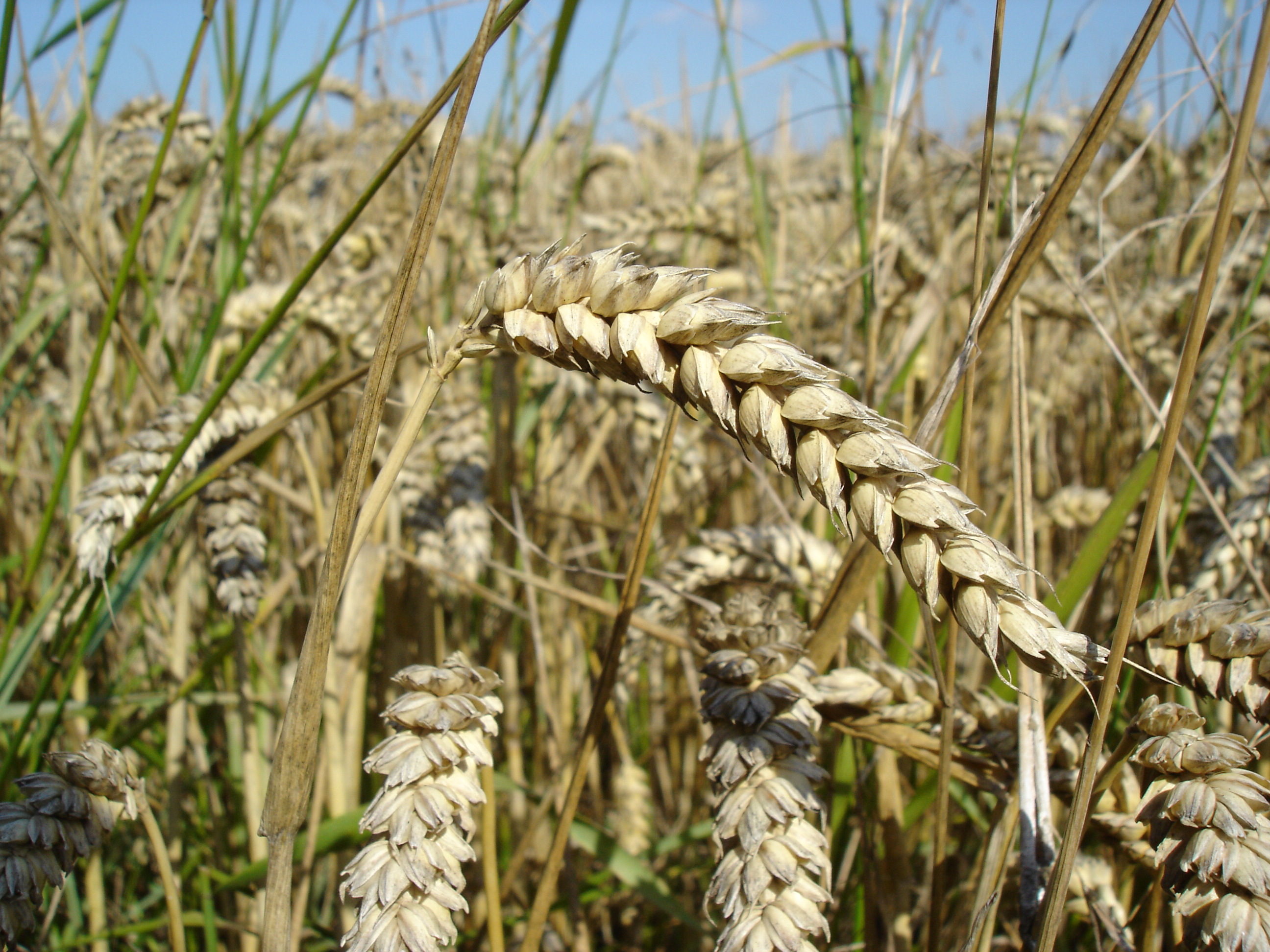
(A wheat field in Dorset, England. Photo courtesy of Joe D.)

So when you buy white grains – white pasta, white bread/buns/tortillas, white rice… it has had the bran removed, and probably the germ as well. What then, class, does that leave us?

Anyone? Anyone? Bueller?

The Endosperm! That low-nutrient left over part, where over half of the vitamin B1, B2, B3, E, folic acid, calcium, phosphorus, zinc, copper, iron, and fiber are lost. That is why the government began requiring grain companies to “enrich” their products in 1941 – they are adding back synthetic versions of the natural health that used to be there, but often in smaller amounts that what was in the original germ and bran. Is this as natural and bioavailable? The jury is still out…

Whole grains are a whole package! In addition to the multiple vitamin, minerals, and fiber stated above, studies are finding more health components: within the whole grain, antioxidants, lignans, phenolic acids, phytoestrogens, and other phytochemicals may help reduce the risk of heart disease, cancer, and diabetes.

The Whole Grains Counsel lists some of the commonly used whole grains. If you're bored with wheat and rice, or are gluten-sensitive, you may see some fun alternatives to try!

Amaranth, Barley, Buckwheat, Corn, Millet, Oats, Quinoa (prounounced KEEN-wah), Rice, Rye, Sorghum/Milo, Teff, Triticale, Wheat (spelt, emmer, farro, einkorn, Kamut, durum, bulgur, cracked wheat, wheatberries), and Wild Rice.


So that sums up the basics of Whole Grains 101!

Whole Grains 102 will cover how to tell if you’re getting a real whole grain. “Wheat bread” just may not be all that you think it is! And in 103, I’ll finally get back to that topic of oats – different types, and why I think oat groats and steel cut oats are worth looking into! And if you’re looking for an advanced class, I’ll be bringing you Whole Grains 201: Sprouting!

Any questions?

“Hallelujah, Amen, Class Dismissed!”

~Katie